



In my previous article, I introduced the Gears framework—a structure that lets Product, Research, Design, and Development teams work at their own rhythms while staying connected at critical moments. Each department operates as its own gear, turning at its own pace, engaging at connection points where one team’s work becomes another’s starting point.
But there’s one gear that works differently from all the others: Product.
While Research, Design, and Development each have their own specialized workflows, Product operates as the coordinating force that powers the entire system. It’s the gear that determines what gets built, why it matters, and how deeply teams should engage to explore it. From wild ideas submitted by customers to production-ready features shipped to users, Product ensures that every rotation—every assignment—adds value back to the product and the people who use it.
Unlike other gears in the framework, Product doesn’t operate as a single workflow. Instead, it functions as a gear train—a series of three connected gears that progress work from idea to observable outcome: Intake, Manage, and Observe.
This article explores how the Product gear train works, with particular focus on the Intake process—the critical first rotation where ideas are captured, screened, and formed into structured assignments. Because without a disciplined way to vet and shape incoming requests, even the best product teams drown in noise.
The Product Gear Train
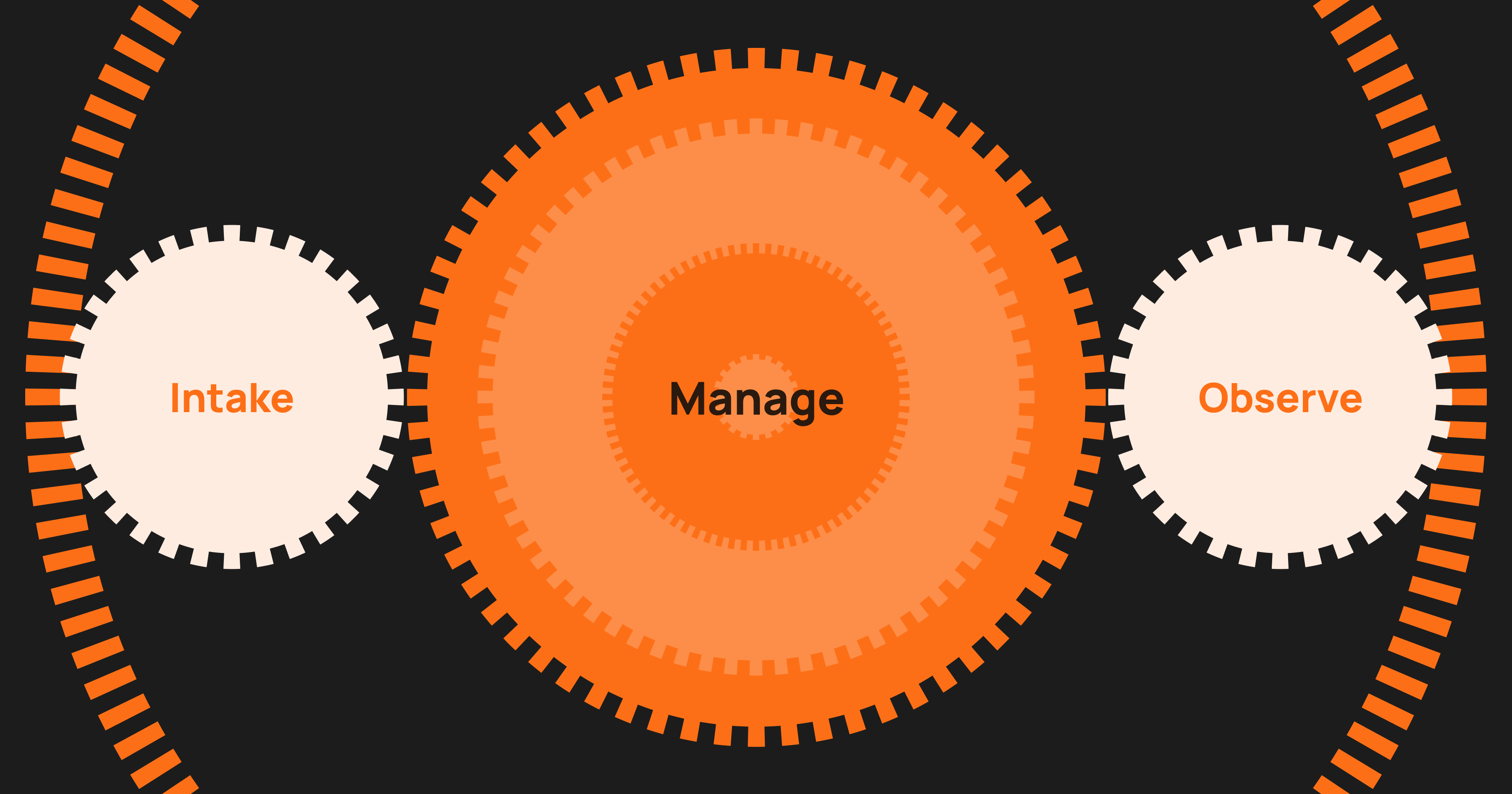
Unlike Research, Design, and Development—which each operate as individual gears with their own workflows—Product functions as a gear train. A gear train is a series of connected gears working in sequence, where each gear must complete its rotation before the next can begin. This sequential structure ensures that every assignment moves through the system with intention, and that no gear spins without purpose.
The Product gear train consists of three gears: Intake, Manage, and Observe.
Intake is the small gear that initiates everything. It captures ideas from across your organization and community, vets them against your product vision, and routes approved concepts forward. Without Intake turning first, nothing else moves—it’s the deliberate starting point that prevents the system from spinning on unvetted ideas or getting stuck sorting through noise.
Manage is the large central gear that coordinates cross-functional work. Once Intake hands off an approved idea, Manage takes over to develop it into something tangible. This is where Product works with Research, Design, and Development to turn a vetted concept into reality—whether that’s validating an assumption, building a prototype, or shipping production-ready code.
What makes Manage unique is its ability to operate at variable depths. Not every idea requires the same level of investment. Some assignments need lightweight discovery to test an assumption, others require working prototypes to validate with users, and some demand full production effort to deliver. This flexibility allows teams to match their engagement to what the work actually requires, rather than forcing every idea through the same heavyweight process.
Observe is the output gear that ensures value delivery. After Manage completes its work—whether that’s shipping a feature or concluding an exploration—Observe measures the outcome against the goals established at the start. Every rotation produces learning, even when the output isn’t what we expected. This closes the loop and ensures nothing is wasted.
Together, these three gears create a system where ideas flow through a deliberate sequence: capture and vet, coordinate and build, measure and learn. Each gear depends on the one before it, and each contributes to the whole. The small Intake gear powers the large Manage gear, which in turn powers the small Observe gear—a mechanical progression that keeps the entire Product system moving forward.
The Intake Gear
Intake is where every product assignment begins. Its purpose is to ensure that ideas—no matter where they come from—are captured systematically, assessed fairly, and routed to the right outcome. The process consists of three phases: Capture, Screen, and Route.
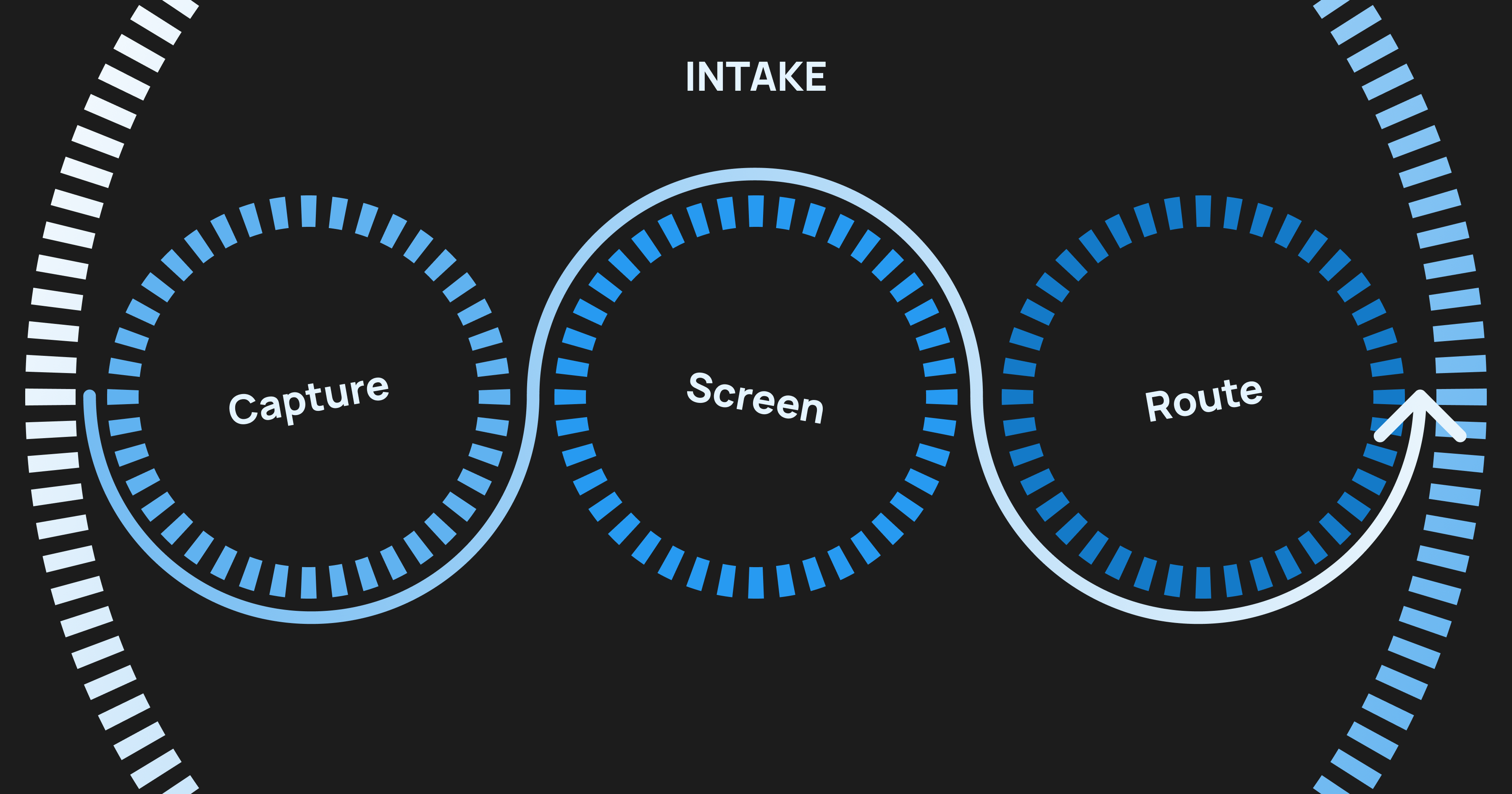
Capture: Gathering Ideas with Context
Product requests rarely arrive polished and ready. They start as wild thoughts—nebulous, unrefined, and scattered across conversations. A customer mentions frustration in a support ticket. A teammate spots an opportunity during a demo. A stakeholder raises a concern in Slack. Without a system to collect these inputs, valuable ideas disappear while others get pursued simply because they were the loudest or most recent.
The Capture Box solves this by providing a single, accessible entry point where anyone in your community—customers, collaborators, internal teammates—can submit feedback and ideas through a simple form. But capturing the idea itself isn’t enough. The form is designed to gather context alongside the request:
What problem is this person experiencing?
What were they trying to accomplish?
Who is affected?
This context matters because users often propose solutions rather than articulating problems. Someone might request “better filtering” when their actual need is faster access to recent items. Or they might ask for “a button to do X” when the underlying issue is that the current workflow requires too many steps. Capturing context helps Product teams understand the need behind the request, not just the suggested solution.
Once submitted, each idea is logged as an issue in a repository, creating a record that can be tracked, referenced, and analyzed over time.
Screen: Systematic Assessment at Scale
With ideas flowing in from multiple sources, Product teams face a volume problem. Manually reviewing every submission is time-consuming and inconsistent—different people assess ideas differently, patterns get missed, and duplicates slip through. This is where systematic screening creates efficiency.
Each logged issue goes through what we call a Fit Check—a rapid assessment that evaluates how the idea aligns with your product vision and strategy, its potential impact on customers, the urgency of implementation, and the effort required to address it. At Khaos, we use an AI agent to perform these Fit Checks, processing high volumes of requests with consistency while documenting the rationale behind each assessment.
The agent doesn’t just evaluate individual ideas—it builds institutional knowledge. By maintaining a Fit Summary that tracks which ideas have been approved, rejected, or identified as duplicates, the agent improves its screening ability over time and helps identify patterns across feedback. Multiple requests for similar functionality become visible. Recurring pain points emerge. The screening process becomes smarter with each assessment.
The goal isn’t to replace human judgment—it’s to handle the volume so Product Managers can focus their time on decision-making rather than sorting and cataloging.
Route: From Assessment to Action
Once screened, issues move into a triage dashboard where Product Managers review the requests and their Fit Checks. This is where strategy meets execution. The Product Team considers how each idea aligns with current roadmaps, evaluates priority in context of other work, and determines the appropriate path forward.
Some ideas are approved—these transfer to the Product repository where they’ll enter the Manage gear and begin the Formation process of becoming Product Briefs. Others are rejected and closed with documented reasoning explaining why they don’t fit the current direction. In both cases, the decision is recorded and transparent.
What matters is that nothing disappears. Every idea receives a clear outcome. Every decision is documented. And when an approved issue transfers to the Product repository, Intake completes its rotation—the small gear has turned, and it’s ready to power the larger work ahead.
How We Built Intake at Khaos
Building Intake at Khaos meant translating these concepts into actual tools and workflows. We use GitHub as our foundation—issues for tracking, projects for organization, and workflows and actions for automation.
