


In my last few articles I introduced Gears, a modular framework for adaptive product development. Those articles touched on how work is delegated and how alignment is achieved between departments. But buried in the DNA of those Gears is a universal building block that drives the entire framework. It exists in each assignment, each task and all the way down to the basic interactions in your ordinary workflow.
I’m talking about the atomic feedback loop.
What is an Atomic Feedback Loop?
You probably ran one this morning. You opened your AI tool, gave it a prompt, read the response. Something was off, so you sent corrections. The back-and-forth continued until you had what you needed. You might not notice it. But this small exchange has a shape, and the shape repeats everywhere.
You'll run hundreds of these exchanges per day. Thousands per assignment. It's so common that most people run them every day without realizing it. Every exchange of information between you and a person, or you and an agent, is an atomic feedback loop that's building on accumulated knowledge, piece-by-piece, until both parties reach an acceptable outcome.
In this article, we'll take a closer look at the loop itself: what it is and when it's done, how to run it well, what to watch for when it breaks down, the pairings it runs in, and how it scales into bigger feedback loops across teams and into larger initiatives.
So what exactly is it, and when is it done?
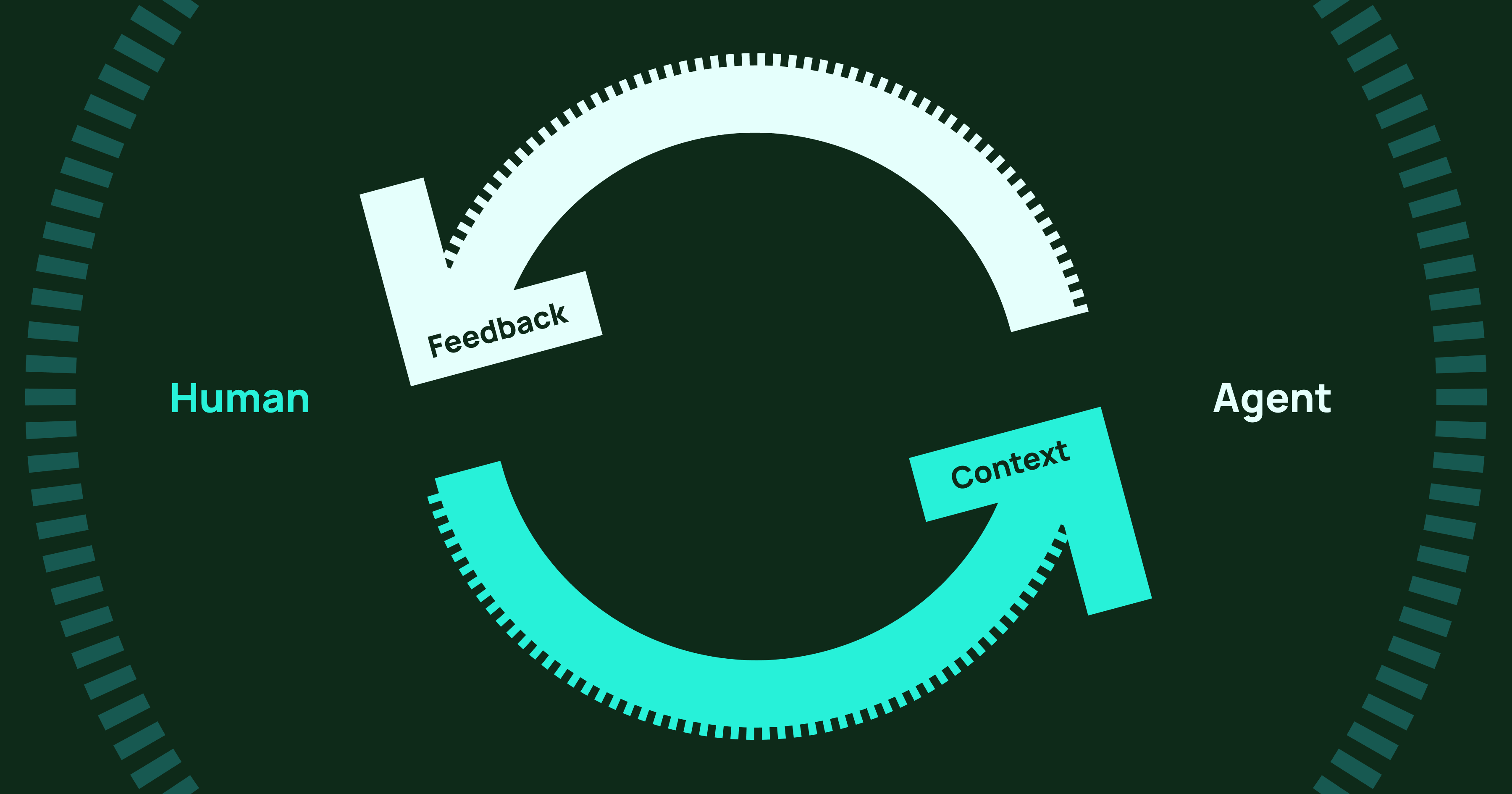
To put it precisely, an atomic feedback loop occurs when two parties exchange information back and forth, refining as they go, until both sides reach an acceptable state. One gives feedback or context. The other processes it and responds. The cycle continues until both agree they've achieved the shared goal.
It’s atomic because it can’t be broken down further. One party has no one to exchange with, and a single message with no reply isn’t a loop.
This is where domain specialists are still highly valued and someone with a blurred role may be a liability. AI agents lower the bar on many tasks, but they don't replace domain expertise, and they certainly don’t replace human judgment.
By embracing the distinct characteristics of Product, Research, Design, and Engineering, we allow specialists to excel in their domains.
Product Managers are more effective building PRDs and roadmaps than performing research
Researchers are more effective developing research plans than mapping out UI patterns and micro-interactions based on competitive layouts
Designers are more effective prioritizing user needs than building the front-end
Engineers are more effective building the security infrastructure than choosing accessible, on-brand color palettes
Every gear has a framework. It's a checklist or workflow each role follows to know when work meets the minimum qualifications to advance. There's subjectivity in every loop, of course, and human judgment is paramount. The specialist checks the work against their framework, brings their own opinion, and confirms the work is ready to move on.
How to run a good loop, and what breaks it
Running one well isn't complicated. A few things matter.
The first is the goal. The more clearly you've defined what you're trying to reach, the more success you'll have reaching it. Vague goals make vague loops.
The second is context, and how you deliver it. Agents do okay with text or visual alone, but they're far more performant with both. That's not unique to agents. Speaking to a person is one thing. Speaking to them, handing them a one-sheeter, and showing them a video that says the same thing is another. They grasp it faster. Agents work the same way: the more they have to analyze, the smarter they are in return. It doesn't matter how you provide context; it matters that you do from more than one angle. And it goes both ways: expect the agent to hand context back to you in more than a wall of text too.
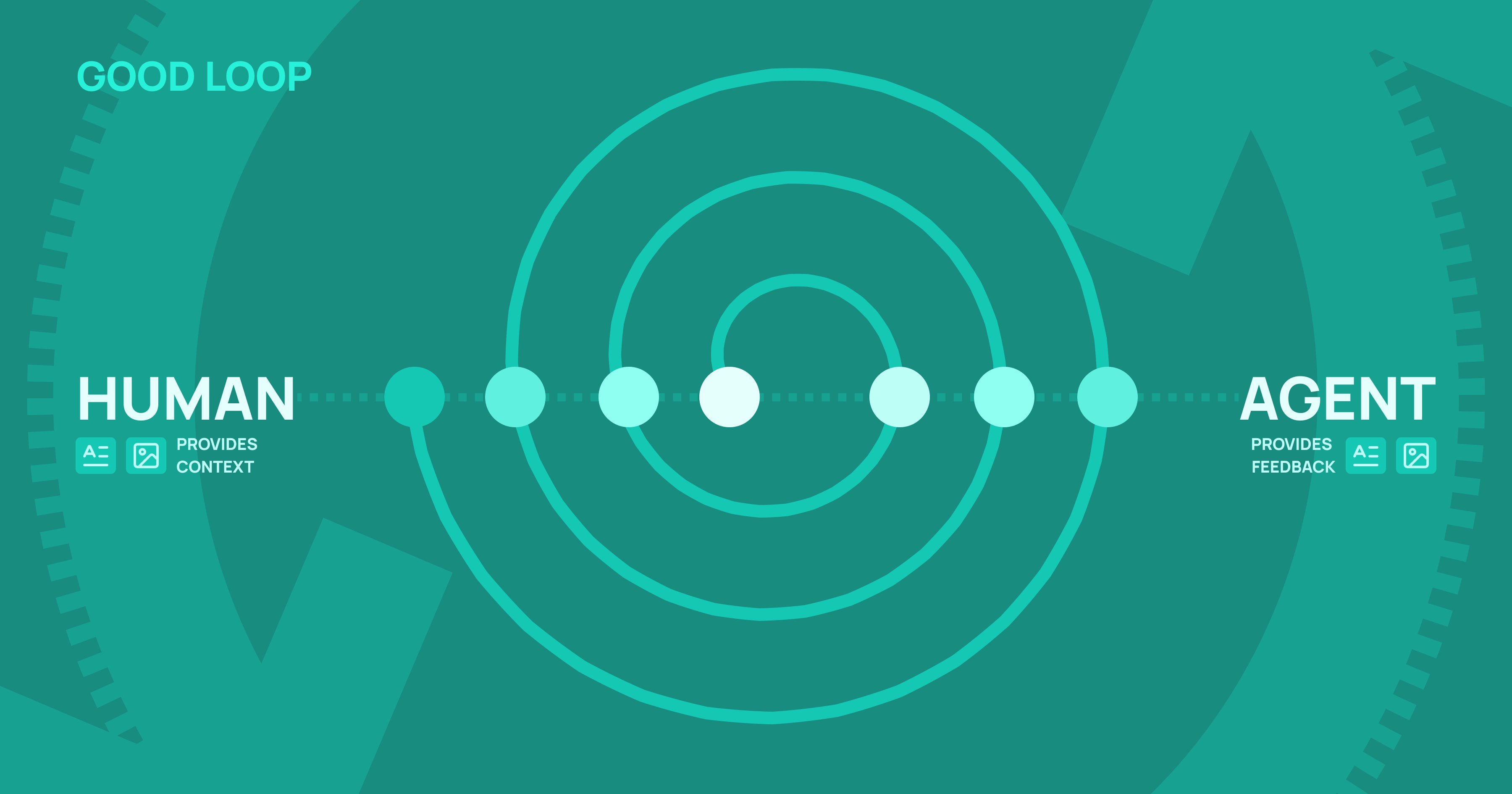
Here's what that looks like in practice. You give the agent context, through text and sometimes images. It responds with text, sometimes visuals like a graphic or an artifact. You read what comes back, find what's wrong, send new feedback and repeat until the work clears the bar.
That's a good loop.
Bad loops
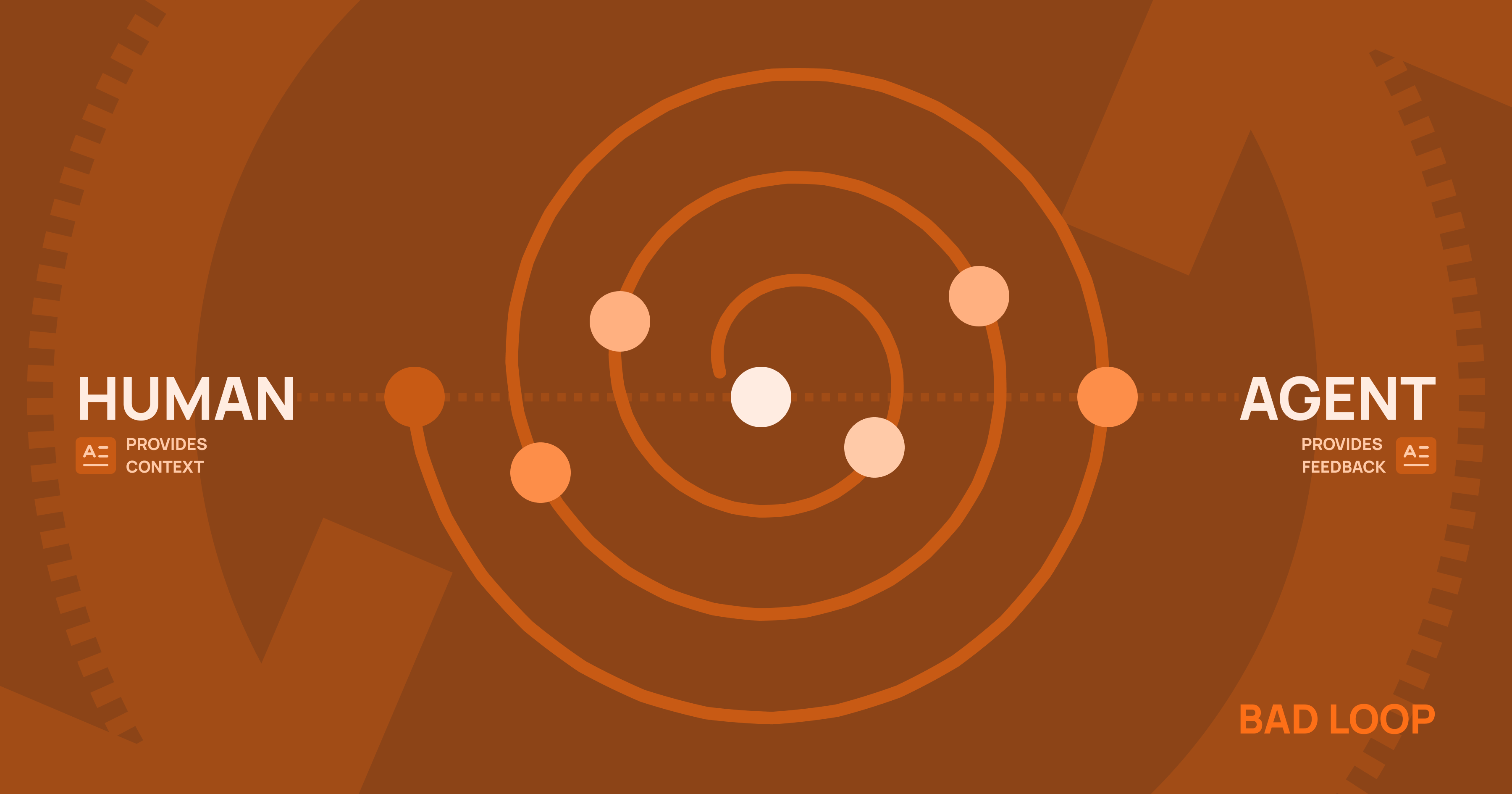
Bad loops feel like they never end. Three failure modes show up most often.
The first is timing. Loop too soon and you're getting feedback on an unprocessed idea. You may be pulled toward something that isn't what you were actually thinking. Loop too late and you've already over-invested in the decision before testing it. You need to be able to articulate your thoughts clearly before seeking feedback. Otherwise you get led astray.
The second is scoping. A loop that drags forever is usually too big. The agent gets confused, your own feedback pivots too much, nothing converges. It’s better to have a more defined goal than it is to ask the agent to do too much.
The third is on the agent's side. The loop breaks down when the agent gets overconfident or misguides you. Usually it's because the agent doesn't know its role or doesn't have the context to act on the information you've given it. This one is harder to spot because confident-sounding output looks like a working loop.
This is where you remember you're the specialist. You set the standard, not the agent. The agent's output is a draft. Your job is to judge whether it meets the bar. In a Human/Agent loop, the final judgment is yours.
The three pairings
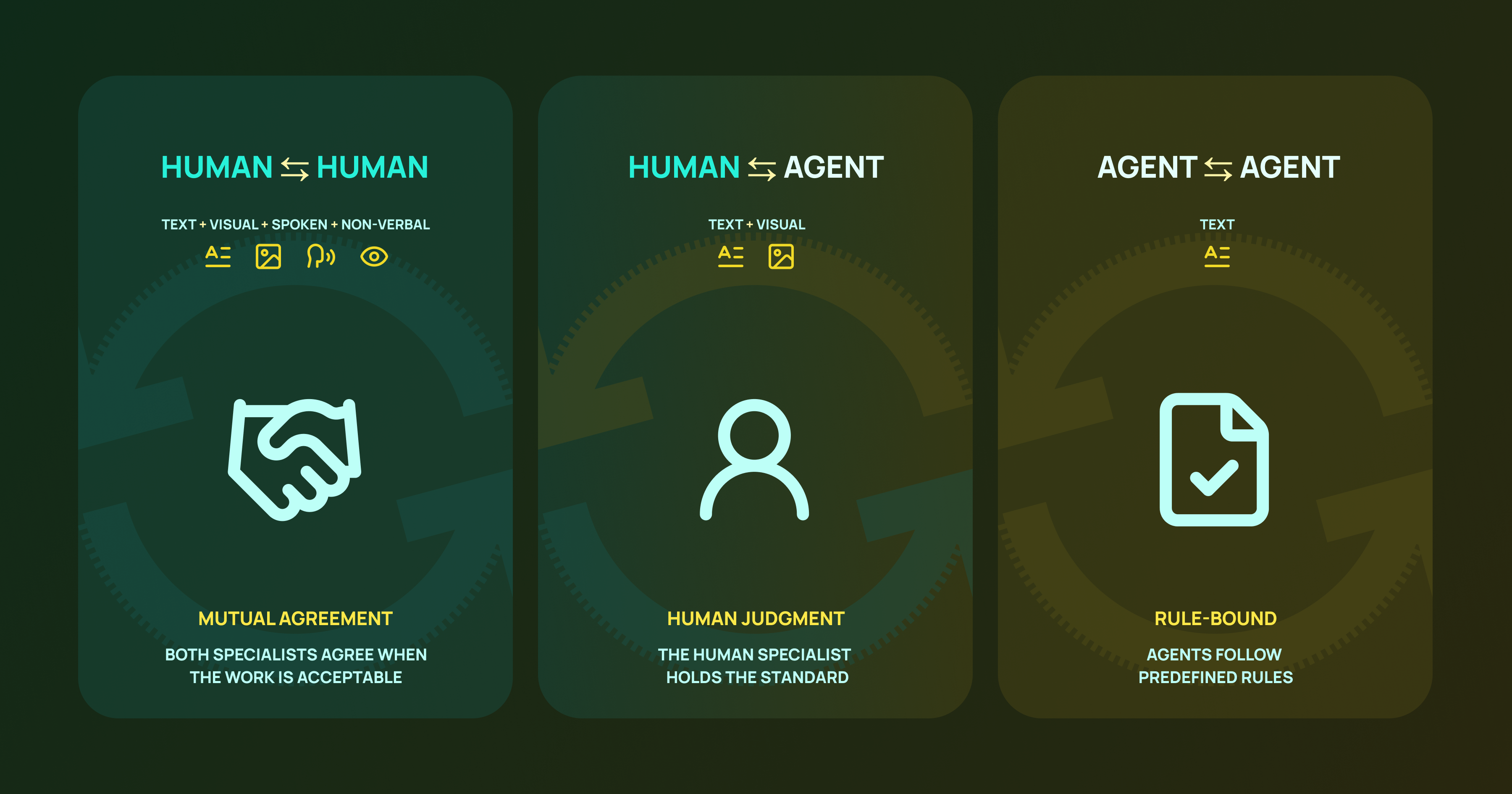
So far we have mainly discussed the Human/Agent pairing, but the atomic loop holds for Human/Human interactions and Agent/Agent interactions.
Humans and agents process information differently. So naturally, there is some tradeoff in the inputs and outputs that each party can send and receive.
Shared across all pairings is the idea that one party's output becomes the other party's starting point.
Human/Human loops
Humans have access to signals that agents don't, such as feelings, tone, pacing, body language and non-verbal cues that accompany words. Humans also bring human limits, like bounded attention, imperfect memory and mental models that color judgment. When two humans interact in a feedback loop, both sides have significantly more signals available to work with than an agent does.
In the Gears framework, I call this exchange a connection point, because it's where the two specialists align and pass work from one gear to the next. Completion is mutual agreement, as both parties hold the standard for their own gear. As such, the work only advances when both parties are satisfied.
Agent/Agent loops
Agents are the inverse of humans. They work from their training data and from the explicit context you provide them. They can't read a room, but they won't get tired or forget what you told them twenty minutes ago either.
The Agent/Agent pairing has the fewest signals to work with, as it can only process context that has been explicitly provided. In this pairing, judgment is rule-bound, so agents close these loops against the predefined criteria, such as a checklist, depending on the workflow.
While different pairings change which signals are available and how the exchange feels, the shape doesn't change. It's still an atomic loop.
Same shape, every scale
In each domain, there are several artifacts that must be generated to accept, scope, plan, produce and deliver work.
Atomic feedback loops can be sequenced together to create larger feedback loops, where a domain specialist accepts an assignment from another specialist, produces the work, and then returns an output to the requester. That’s a full rotation of a gear. If work is rejected or needs iteration, the gear can rotate again. That’s a feedback loop.
To better understand this concept, let’s look at an example using the Research gear.
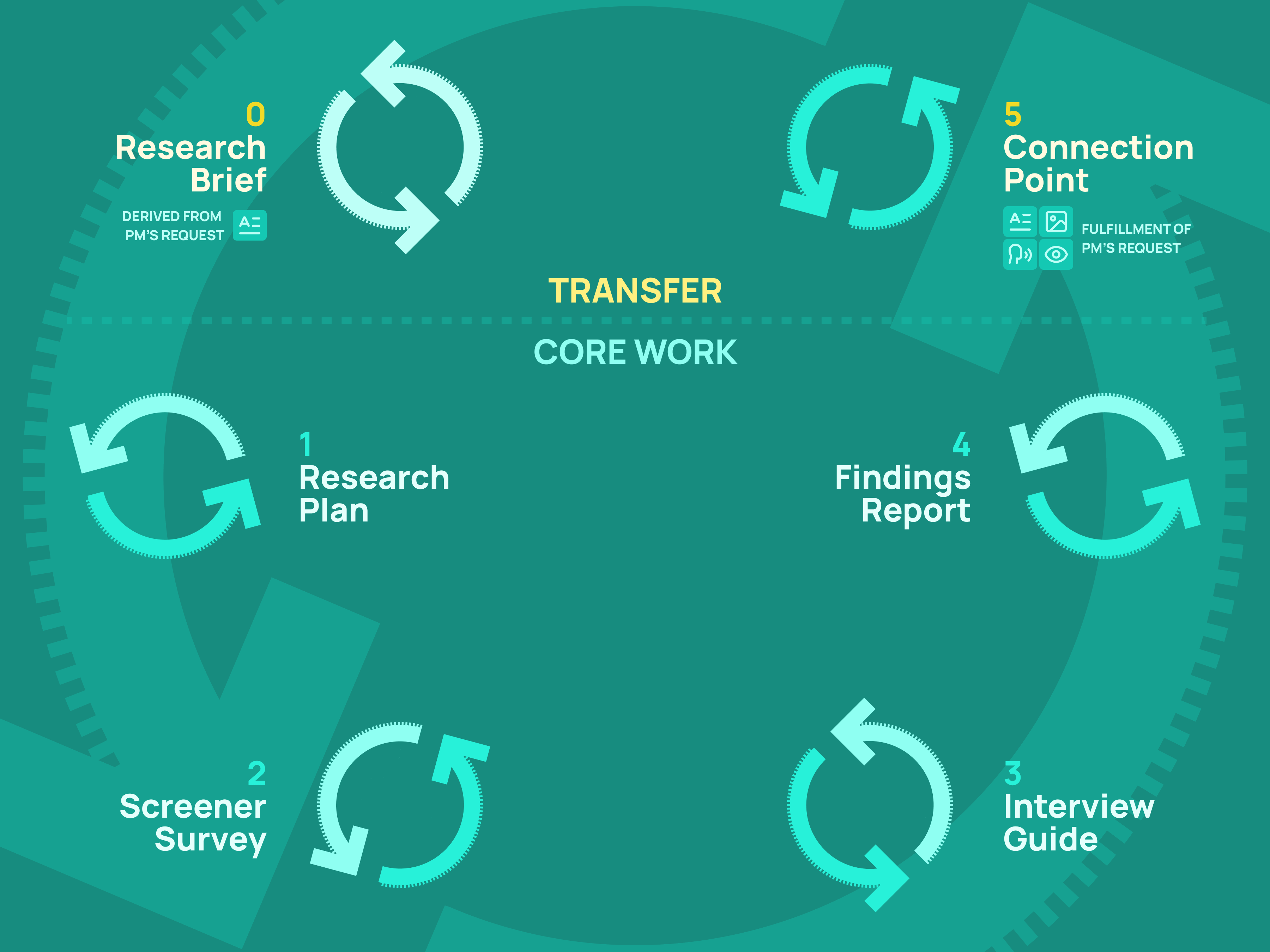
Let’s say that a Product Manager wants to understand how customers are acclimating to a new feature. The PM will submit a research request, which will be converted to a Research Brief for the researcher (me) to pick up. This transfer of information is the first connection point in a Human/Human loop.
As the researcher, my job is to complete one rotation of the Research gear, using atomic feedback loops to create different artifacts.
After reading the brief, I'll have to develop a research plan. I work with an agent to explore the ideas in the brief, using my judgment as a researcher to decide the right hypothesis, experiments, methodologies and more. We'll refine through a feedback loop until I have a publishable plan.
Let's say the plan calls for participant interviews, so I'll also need to develop a screener survey. That will require another feedback loop with an agent to develop that artifact.
Then I need to develop an interview guide with questions to ask participants. That's a third artifact and another feedback loop.
Once interviews are done, I'll work with an agent to synthesize the data and capture the insights that will be presented in a final report. This is another feedback loop to create that artifact.
That's four feedback loops to complete the core work of the Research gear.
Once the report is complete, I connect with the Product Manager who requested it and present my findings. That connection point is the return in the Human/Human loop, transferring new knowledge back to the originating party.
This is just an example. Some assignments need fewer loops, some need more. The count varies with the work, and so do the two parties. In this example, a researcher and a PM exchanged feedback at the connection points. In another gear, it could be a designer and an engineer. The shape is the same.
When all the gears work together, they form a bigger feedback loop, called an engine. The engine that takes an idea from concept to shipped product is itself a loop. The team and its customers exchange context and feedback with each other for continuous refinement: the team ships, customers respond, the team improves and ships again.
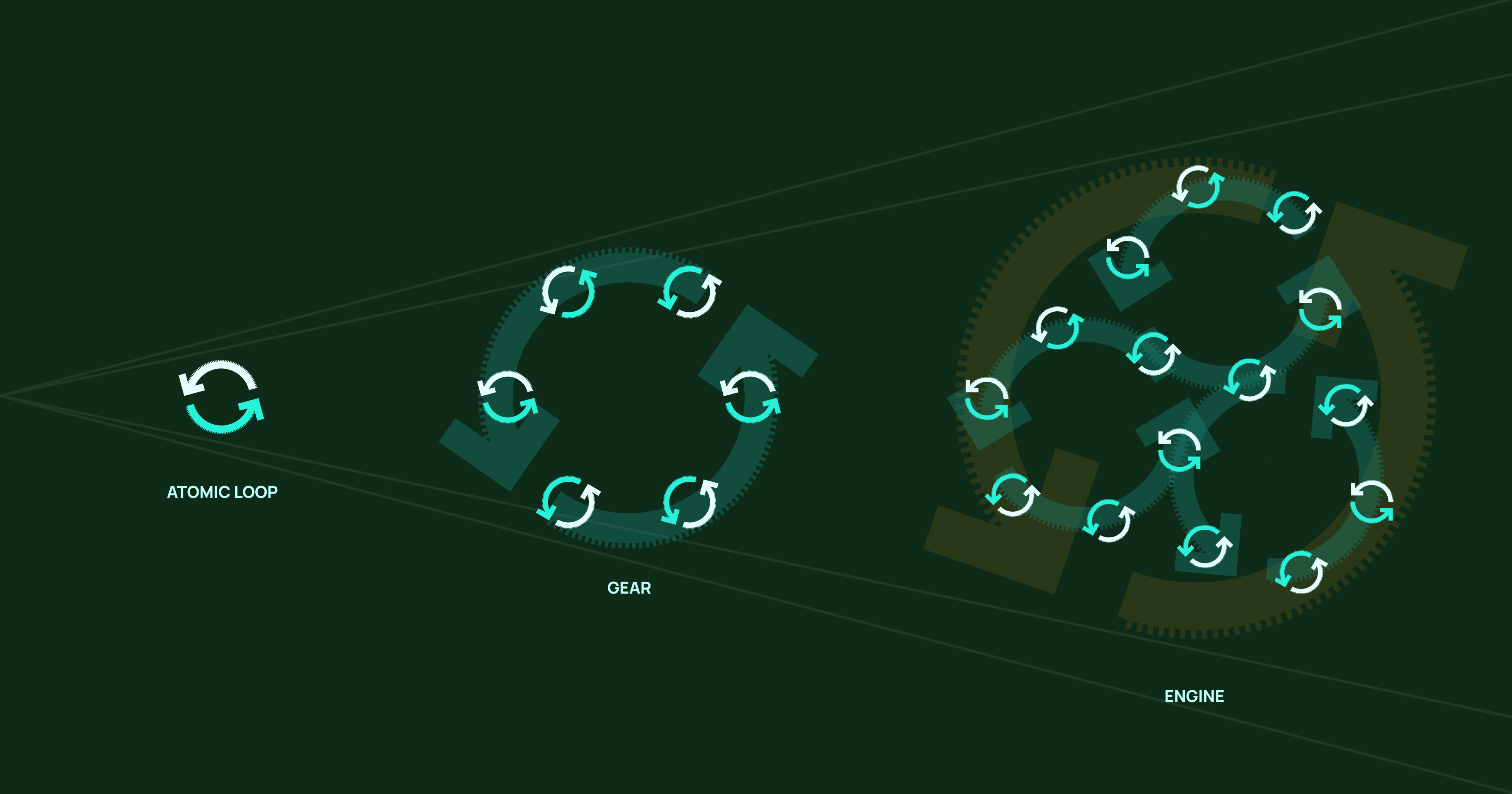
The shape doesn't change as you zoom out, only the scale does.
Now you'll see the loops everywhere
You were already running these loops, every day, probably without noticing. Now you have a name for them, and you'll start seeing them everywhere.
The same shape runs a single exchange with an agent, a full rotation of a gear, and the engine that carries an idea from concept to shipped product. It doesn't change as you zoom out. Only the scale does.
That's what makes the loop worth your attention. Everything you build is made of it. The feedback loop is inescapable.
The loop itself is where your effort pays off. Run the unit well: a clear goal, context from more than one angle, the judgment to know when the work is done. Refine the loop, and you refine everything.
Simple. Quality. UX & Product Design is a reader-supported publication. To receive new posts and support my work, consider becoming a free or paid subscriber.